Freewriting

Screen Shot 2016-05-22 at 8.35.10 AM

We are often asked by those who sometimes have a little fear or intimidation regarding the written word about a good way to get started when we just have to produce something. Our preference is to engage freewriting, a method that tends to clear the mind and capture focus, albeit in a roundabout way.


The premise of freewriting is to put a pen to paper, or fingers to the keyboard, and write without stopping for a minimum of 10 minutes. You can start with your topic in mind, but don’t stop writing or pause to think for the full 10 minutes – write whatever comes to mind, even if it has nothing to do with your desired subject. Write words, phrases, a description of the weather, anything. Don’t correct anything, worry about spelling, punctuation or any other things that might distract from the writing.


At the end of the exercise you’ll be exhausted, but the premise of freewriting is that somewhere buried in the stream of consciousness output will be cogent ideas, interesting sentences, and threads of narrative that get you started on the project at hand. That is where we begin to find the focus and the ability to get started.


Peter Elbow, the great writing coach with the University of Massachusetts at Amherst, talked about the exercise this way:


“Freewriting may seem crazy but actually it makes simple sense. Think of the difference between speaking and writing. Writing has the advantage of permitting more editing. But that’s its downfall too. Almost everybody interposes a massive and complicated series of editings between the time words start to be born into consciousness and when they finally come off the end of the pencil or typewriter onto the page. This is partly because schooling makes us obsessed with the “mistakes” we make in writing.”


And, therein, lies the root of that kernel of fear, intimidation, or just uneasiness that we sometimes get when it comes time to write. Freewriting is a method that lives up to its name. Without judgment of any kind, you are free to write in the stream of consciousness exercise.


In the freedom of the freewrite, we often find the inspiration, form and function we need to get started

Right Words: Part 1

Screen Shot 2016-05-01 at 12.12.33 PM

Some of the most common mistakes in writing and editing involve selection of the right word when we have the choice of similar words. And, as we continue to emphasize, getting it right in writing is important because a knowledgeable reader or listener makes judgments about us based on how we present.


From time to time, we will take some time to discuss words like the ones below. Feel free to cut and paste to make your own master list of reminders. Here are some examples:


Affect and Effect – This is one you just memorize. Affect is a word of action, usually a verb, and means to have an impact on something else. The weather affected our travel. Effect means to influence or create. What effect will the weather have on our travel?


Farther and Further – This is really a sticky one as both can relate to distance or additional information depending on sentence construction. The easiest way to get them right is to think of farther as most often related to distance. We came to the crossroads but still had farther to go. Think of further as most often related to more, as in furthermore. I have no further thoughts on the matter.


Insure and Ensure – To insure something is to protect it against loss, as through an insurance policy. We need to insure the car before we drive it. To ensure something is to make certain. Please ensure that you make the bank deposit today.


Compliment and Complement – A compliment is typically a favorable comment we make about someone or something. The nice thing he said about my painting was quite a compliment. To complement generally means to supplement. The addition of green to the painting was a nice complement.


It’s and Its – The easy method of proper usage is to know that the apostrophe represents a contraction that stands for it is. Read your sentence out loud substituting it is and you will hear immediately if it’s wrong. Without an apostrophe the word does not stand for it is, but rather refers to another word in the sentence. The company released its statement today. The its stands in as a pronoun for the company. Try reading the sentence substituting it is and you will hear immediately that it’s wrong or right.

5 Steps to Healthy Writing

murray2

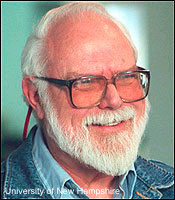
In the world of print journalism one of the icons of effective writing was the late Don Murray, a Pulitzer Prize winner, Boston Globe writer, an editor for Time, and author of more than a dozen books.


Murray believed everyone had the capacity to write with power and clarity. One of the key elements is to understand the process of writing, particularly in the kind of non-fiction most of us do every day, whether writing a short email or a longer piece. The elements of organization remain the same.


What Murray taught journalists is that formation of a compelling story unfolds in five parts:


Selection:  The first element is for the writer to decide what the point of the writing is. Then lead with the point. Help the reader get right to the essence of why we are writing.


Reporting:  “Effective writing is built from specific, accurate information,” Murray said. Too often when writing a memo or a report, we embark on long exploratory or overly contextualized narrative before clearly delivering the message. The reader appreciates specifics without overly complex preamble.


Organization:  “Organizing…is the technique I use most often to find productive focus for what I’m writing,” Murray said. “I look for an event, a quotation, a statistic, an anecdote, an individual, a place, a process, a revealing detail which can be the seed from which the entire piece of writing will grow.”


Drafting:  Once the fundamentals of beginning to write are under way, we write. Or, as Murray said, we draft. For Murray, the draft is the time of discovery and reflection. Once written, the writer then has opportunity to review what has been written and make sure the intent, the focus, the selection, reporting and organizing is clear.


Clarifying:  Murray believed “the most satisfying part of the writing process comes when there is a draft that can be shaped into meaning by the writer’s hand.” Murray advises to never ask whether the writing is good or bad. More helpful, he says, are the questions: “What works?” and “What needs work?”


Murray believed brevity creates vigor and clarity. “The more complicated the subject, the harder to understand, the more important it is to use the shortest words, the shortest sentences, the shortest paragraphs that communicate the meaning without oversimplifying and distorting it.”


He also believed the process of rewriting was a gift of opportunity rather than drudgery or punishment. In “Read to Write” Murray quoted playwright Neil Simon: “Rewriting is when playwriting really gets to be fun. In baseball you only get three swings and you’re out. In rewriting, you get almost as may swings as you want and you know, sooner or later, you’ll hit the ball.”


Misplaced Modifiers

HW Modifier 3

At a nice hotel in New York recently we saw this sign prominently displayed on the registration desk:


Hearing Impaired Devices Available Upon Request


We have several devices like a cell phone, a tablet, a computer, and so on. None of them, as far as we know, are hearing impaired. But, apparently at this hotel we could request a device that is hearing impaired.


In writing, this is a classic example of a misplaced modifier. A modifier, if we remember or lessons from elementary school, adds additional information to the word or words it precedes or follows. So, in this case, the words “hearing impaired” refer to a characteristic of the device, the word that the preceding words modify. What the sign meant to say is: Devices for the hearing impaired are available upon request.


As we communicate in places like the 140-character Twittersphere, we push for economy of words to get our point across. Sometimes, that means we get a little sloppy with the rules of structure. In the process we undermine clarity for the reader.


There are plenty of examples of misplaced modifiers around, but a few of my favorites were compiled by the Writing Center at the University of Wisconsin – Madison:


She handed out brownies to the children stored in Tupperware. We fix this by moving stored in Tupperware closer to the brownies it modifies, and therefore we release the children who were stored in Tupperware in the original sentence.


Think about what the following sentences actually say and how to fix them:


He held the umbrella over Janet’s head that he got from Delta Airlines.


I smelled the oysters coming down the stairs for dinner.


Oozing slowly across the floor, Marvin watched the salad dressing. This one has clarity issues on multiple fronts.


One need not know grammar to fix sentences like we see here. A quick trick journalists use is to read their work aloud before they push the send button. The ear almost always provides the edit.

Vaporous Storytelling

Screen Shot 2016-03-13 at 10.22.55 PM

Recently we came across this communication from a healthcare system to its patients or consumers or customers or external stakeholders, or whatever your preference is to describe your constituency:


In the disruptive and rapidly changing environment of healthcare, our hospital system is leading a paradigm shift in patient-centered care using data-driven models to pursue innovation in quality, service and compassion. Here, we challenged ourselves to think outside the box and color outside the lines, tearing down internal silos to achieve a higher level of collaboration in cross-functional teams. At the end of the day, that means our patients can trust us to be a partner of choice for them individually and for their families. Our dedicated physicians, physician extenders, clinical service providers, nurses, environmental services staff, food preparation specialists, board of directors, community volunteers, administrators (and other categories of internal stakeholders we can’t remember right now) work tirelessly 24/7 to ensure our patients and their families have a 5-star experience in our newly remodeled facility, complete with the most advanced state-of-the-art technology. More importantly, we are committed to positively moving the needle of medical delivery and creating easy access to the highest quality care close to home.


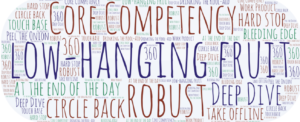
You’re right. This is not an actual communication, but it comes uncomfortably close to some we’ve seen. We constructed it ourselves from a list of common corporate clichés and vaporous writing we collected from meetings, memos, emails, advertising and the like. The words and phrases are not specific, lack power, and communicate very little, though the story tries to take a position of lofty importance.


Depending on how one counts, the sample story in 168 words manages to pack in more than 20 vaporous phrases. For example, what does data-driven actually mean, especially to a consumer? What are cross-functional teams and why should a patient care? Why is the institutional and distant word “facility” such a favorite in healthcare to describe where we practice our patient-centered care? If we drive innovation or move the needle, what actually happens that might be meaningful to a customer?


In healthy writing, we should try to wrap our heads around the elephant in the room and consider how to consistently achieve the basic blocking and tackling of clarity in our communication. Sometimes we need to eat our own cooking. In the perfect storm of busy schedules and limited bandwidth, where we feel at times like we are drinking from a firehose, each of us has an opportunity to cast ourselves and our companies in a better light by choosing words more wisely. Together, let’s blue-sky this, put a stake in the ground, go after the low-hanging fruit, get some quick wins, and take it viral.


We believe this last paragraph added at least a dozen more to the list we’ve assembled here. Remember, if it looks like a duck and quacks like a duck, it’s probably a cliché so purge it from your vocabulary and your writing.

Lessons from the Masters


Mark_Twain 2

From time to time we find it useful to reflect on lessons from great storytelling masters and to let them guide us on the journey toward healthy writing.

One of our favorites is Mark Twain, who had both wisdom and wit when he talked about the art and craft of the power of words.

For example, an adjective adds additional information to the word that follows, such as blue Mercedes. But using too many adjectives, especially non-specific ones, can make writing bloated and less powerful. Our healthcare friends like to use adjectives like state-of-the-art facility, or cutting-edge technology, or innovative advanced medicine, and so on. These types of adjectives have become buzzwords in the industry and, as Shakespeare might say, they are “full of sound and fury, signifying nothing.”

Healthy writing uses precise words to paint a clear and specific picture in the mind of the reader. As Twain advised: Don’t say the old lady screamed. Bring her on and let her scream.

Regarding adjectives, here is what Twain wrote to one young student:

I notice that you use plain, simple language, short words and brief sentences. That is the way to write English – it is the modern way and the best way. Stick to it; don’t let fluff and flowers and verbosity creep in. When you catch an adjective, kill it. No, I don’t mean utterly, but kill most of them – then the rest will be valuable. They weaken when they are close together. They give strength when they are wide apart. An adjective habit, or a wordy, diffuse, flowery habit, once fastened upon a person, is as hard to get rid of as any other vice.

To another he wrote: Substitute ‘damn’ every time you’re inclined to write ‘very’; your editor will delete it and the writing will be just as it should be.

In his essay, Report to the Buffalo Female Academy, Twain was commenting on judging student writing compositions and noted of one winning entry: It shows a freedom from adjectives and superlatives which is attractive, not to say seductive – and let us remark instructively, in passing, that one can seldom run his pen through an adjective without improving his manuscript.

There is no doubt the adjective is a legitimate device for powerful writing, as long as it is not overused. Twain again on the subject: God only exhibits thunder and lightning at intervals, and so they always command attention. These are God’s adjectives. You thunder and lightning too much; the reader ceases to get under the bed, by and by.

Healthy writing that engages the reader is a conscious habit to be developed, but it need not be an all-consuming enterprise in an already busy world. Slowing down slightly to write deliberately and clearly sends a positive message about us to the ones who receive the writing.